The Suit That Has to Hold Against the Lunar South Pole
Prada and Axiom Space have spent three years engineering the spacesuit that will carry the first woman to the lunar surface. The collaboration is less about branding than about what happens when a fashion house treats material science as its native language.
The relationship between fashion and outer space has always been somewhat adversarial — one devoted to the surface pleasures of fabric and silhouette, the other to survival in conditions that would destroy both within seconds. And yet the Apollo program dressed its astronauts in suits assembled partly by ILC Dover, then better known as a manufacturer of Playtex bras; the logic of pattern-cutting and technical textile construction has never been as distant from the vacuum of space as it might appear. When André Courrèges sent models down the runway in 1964 wearing white vinyl boots and silver-threaded tunics, he was not predicting the moon landing — he was claiming it as an aesthetic horizon. Paco Rabanne's chainmail dresses that same decade seemed to promise a future in which the human body might need armor against something more radical than weather.
In October 2023, Axiom Space confirmed that it had selected Prada Group as its design and materials partner for the AxEMU — the Axiom Extravehicular Mobility Unit — the next-generation spacesuit destined for NASA's Artemis missions and the first human return to the lunar surface since Apollo 17 in December 1972. One year later, the outer suit was unveiled at the International Astronautical Congress in Milan, then placed on public display inside the Galleria Vittorio Emanuele II. This past June 7th, at Prada's SoHo flagship in Manhattan, the collaboration advanced further: the two companies presented the Liquid Cooling and Ventilation Garment, an engineered knit inner layer that circulates cold water through integrated tubing placed across major muscle groups, delivers fresh oxygen to the wearer's face, and removes exhaled carbon dioxide — all within a form-fitting silhouette designed to support eight-hour moonwalks at the lunar south pole.
The collaboration is not, strictly speaking, a fashion story. But it is a Prada story.
Why the Timing of This Partnership Is Not an Accident
There is a version of the fashion-in-space narrative that collapses quickly into novelty: a recognizable logo on a helmet, a branded color stripe on a utility piece. The Prada-Axiom partnership resists that reading, at least partly because Prada's technical credentials are not borrowed for the occasion. The house has operated Prada Linea Rossa since 1997, a sportswear and performance line born from the brand's involvement in the America's Cup — a project in which the constraints of high-performance sailing became a generative design problem rather than a set of limitations to work around. That instinct for functional constraint as creative structure is precisely what Axiom Space appears to have recognized when it selected the house. Lorenzo Bertelli, Prada Group's Chief Marketing Officer, has described the brand's "vertical integration and operations management" as central to making the partnership viable — a phrase more at home in an aerospace procurement document than a fashion press release, and all the more telling for it.
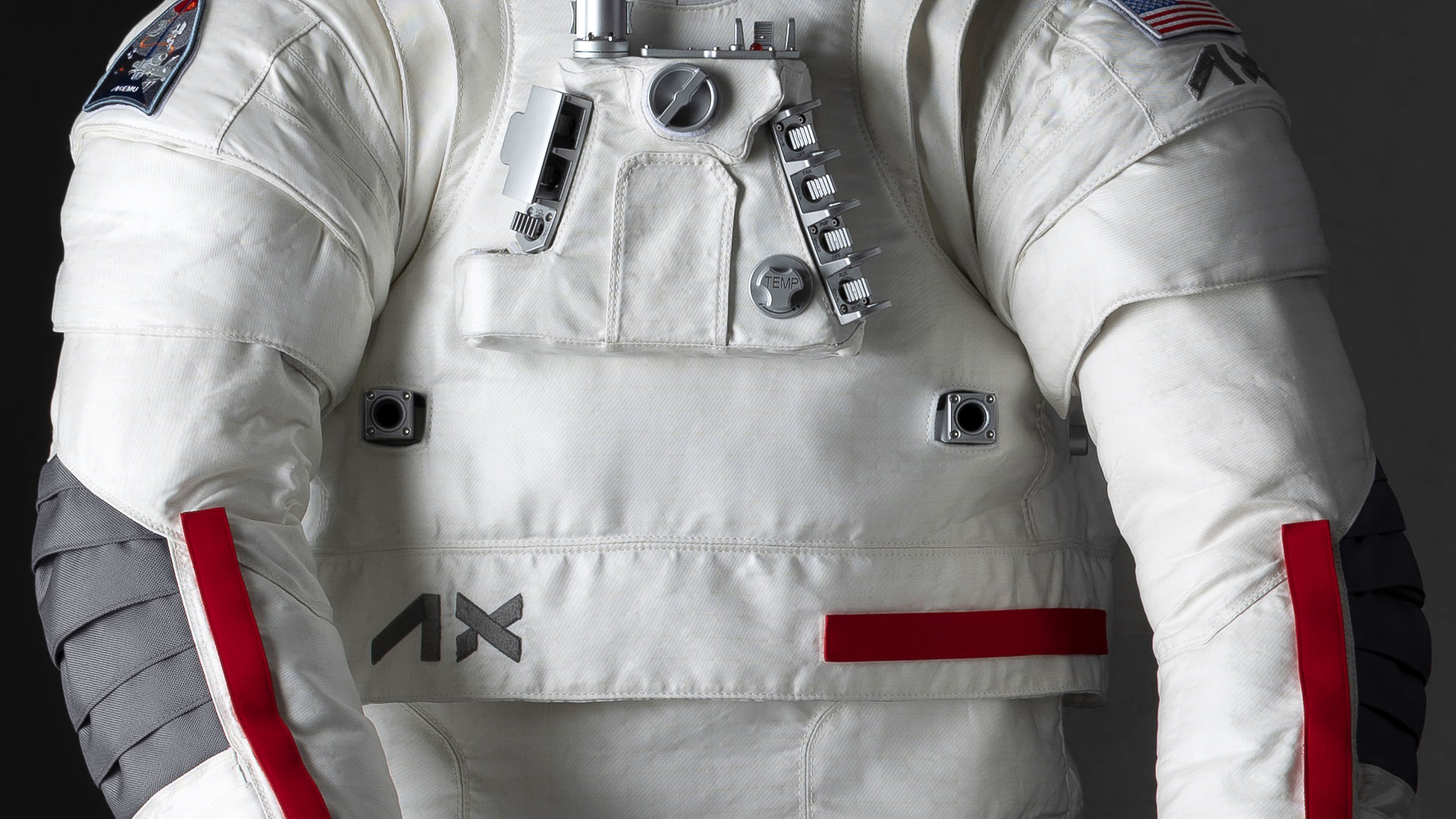
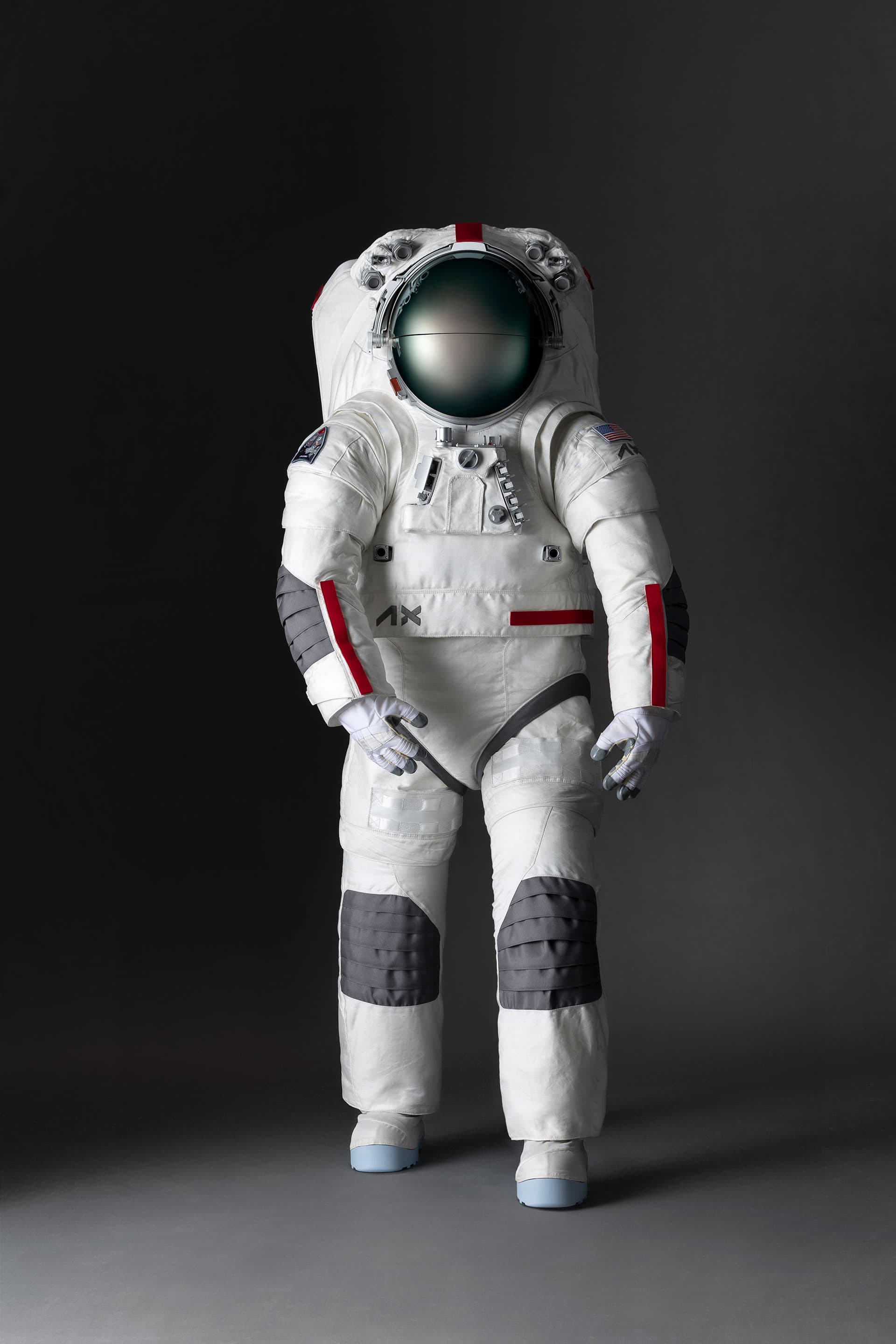
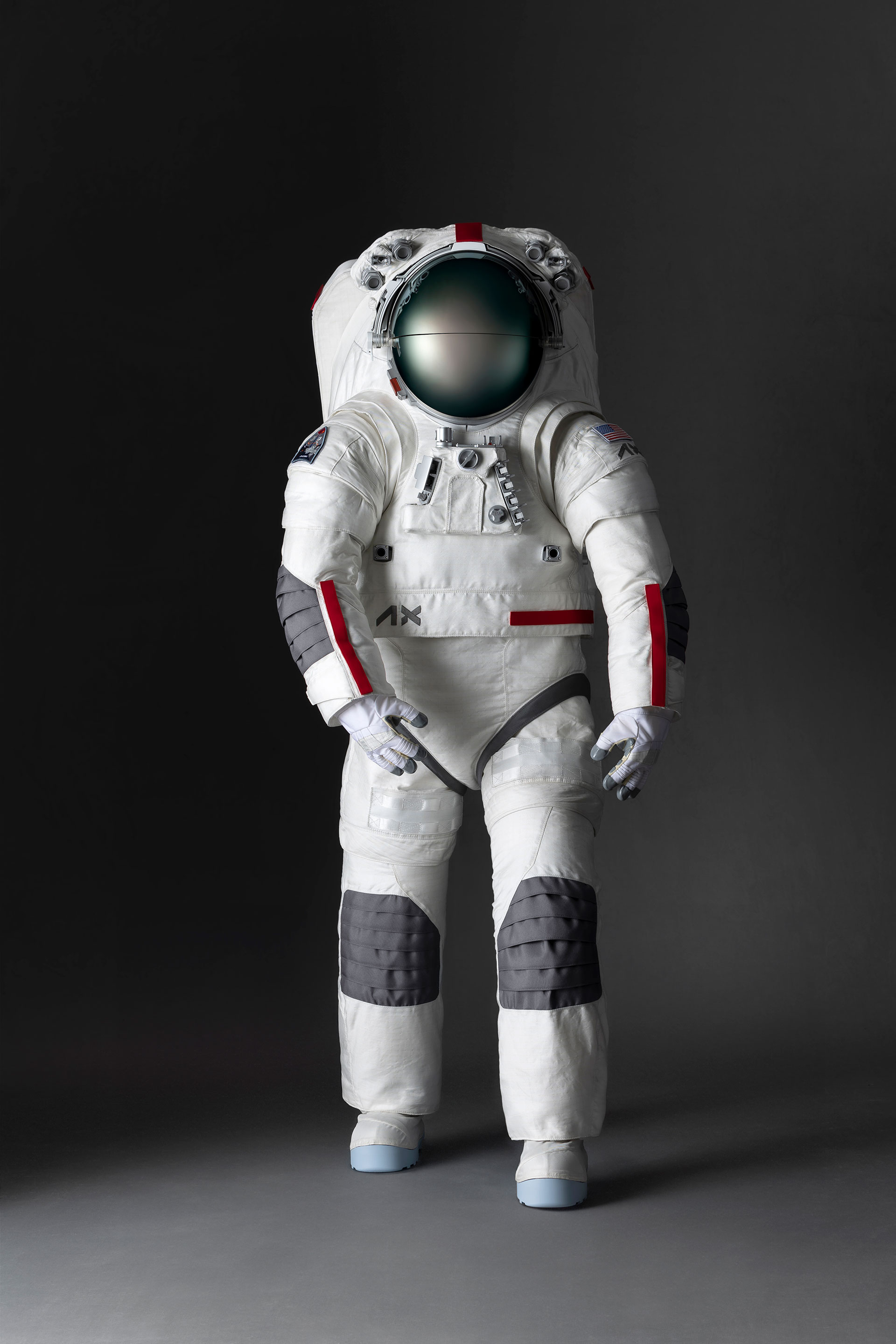
The AxEMU outer suit — white to reflect heat and render lunar dust visible on the surface, with dark gray reinforcement panels at the elbows, knees, and hip joints, light blue boot soles that echo Apollo-era overshoes, and the characteristic Prada Linea Rossa red line running through the helmet and portable life-support system backpack — required Prada's engineering teams to work alongside Axiom's systems team through every phase of development. The white is not aesthetic: permanently shadowed craters at the lunar south pole reach temperatures of minus 250 degrees Celsius, and albedo is a survival condition. The red is a functional marker for crew distinction, not a colorway decision. The gray is protective reinforcement. Axiom Space holds a $228 million NASA contract for the suits, drawn from a broader $1.3 billion Artemis infrastructure investment — a context in which the role of fashion expertise is structural, not decorative.
The Liquid Cooling and Ventilation Garment, unveiled in New York this June, is the deeper expression of what Prada brings. Built through advanced three-dimensional modeling, it incorporates an engineered knit structure with specialized fibers selected for repeated, long-duration use — approximately 500 manufacturing hours per garment. The cooling circuit carries full redundancy: a backup loop in the event the primary fails at temperatures and distances from which emergency extraction is not a practical option. "Every minute astronauts spend outside their vehicle, the LCVG is working to keep them safe," noted Axiom's Russell Ralston, Senior Vice President of Spacecraft Development — a sentence that would be jarring in any conventional fashion context, and clarifying in this one.
“The suit that has to hold against the lunar south pole does not begin with aesthetics. It begins with thermal physics, fiber selection, and pattern engineering — which is, in the end, where Prada has always begun too.”
I find the choice of the Galleria Vittorio Emanuele II for the October 2024 public installation the most revealing editorial decision in this collaboration: a nineteenth-century iron-and-glass arcade conceived precisely as a theater for consumer desire, used to display an object whose function is to prevent the person wearing it from dying. The tension between those two registers is not resolved by the installation — it is the installation's subject.
Prada's Strategy, Written in Technical Fiber
For Axiom Space, the Prada partnership solves a perception problem as much as a materials problem. Private space companies require public credibility, and credibility in a cultural economy is built partly through adjacency — through what a collaboration signals rather than only what it technically delivers. Prada's involvement positions the AxEMU as an engineered object with ambitions to quality and longevity beyond the expectations of a government procurement. "The future of space exploration will not be built by any one entity alone," said Axiom CEO Jonathan Cirtain at the unveiling — a statement that reads as both idealism and commercial strategy, and is not less true for being both.
[!GRID src="https://gizmodo.com/app/uploads/2026/06/Axiom-Prada-LCVG-and-spacesuit-exterior.jpg" alt="The Prada-Axiom LCVG inner layer displayed alongside the full AxEMU suit exterior in New York" text="The LCVG alongside the full AxEMU exterior, June 2026 — two separate engineering problems resolved in a single collaboration. Via Gizmodo."]
For Prada, the calculation runs in the opposite direction. The house has spent three decades establishing that design and craft are not the same proposition; that research, material intelligence, and technical innovation are as much a part of the brand's identity as the triangle logo or the original nylon backpack of 1984. The Axiom collaboration extends that argument into a domain where the consequences of a material failure are not a critical review but a life at risk. Bertelli referenced the Apollo missions as the last moment when the space industry genuinely pushed hard against what was possible — suggesting that the collaboration is framed internally not as a marketing exercise but as a historical positioning.
The suits will undergo in-flight testing at the International Space Station before deployment to the lunar surface, and are targeted for use on Artemis IV in 2027. This is not a collection in any sense the fashion calendar would recognize. It does not have a delivery window or a lookbook. It has a launch date and a NASA approval process.
The first woman to walk on the Moon will be dressed, in part, by a house known for nylon and resin. That is not the story the fashion industry expected to write — which may be exactly why Prada wrote it.
The AxEMU spacesuit and the Liquid Cooling and Ventilation Garment are not available for purchase. The collaboration spans the full development and testing cycle of Axiom Space's next-generation lunar extravehicular suit program for NASA's Artemis missions, with lunar deployment targeted for 2027. Further information is available at [axiomspace.com](https://www.axiomspace.com) and via the [Prada x Axiom Space project page](https://www.prada.com/es/en/pradasphere/special-projects/2024/prada-axiom.html).
Frequently asked
About this piece
What is the Prada Axiom Space spacesuit?
+
The AxEMU (Axiom Extravehicular Mobility Unit) is a next-generation spacesuit developed by Axiom Space in partnership with Prada Group for NASA's Artemis lunar missions. Prada contributed expertise in raw materials, advanced knitting, and three-dimensional modeling to both the outer suit and the inner Liquid Cooling and Ventilation Garment.
Why did Axiom Space choose Prada as a design partner?
+
Axiom Space selected Prada for its technical expertise in raw materials, manufacturing techniques, and innovative design — specifically its vertical integration, operations management, and proven ability to work with high-performance fibers and complex construction methods through its longstanding Linea Rossa sportswear program.
What is the Prada Axiom Space LCVG?
+
The Liquid Cooling and Ventilation Garment is the engineered knit inner layer worn beneath the AxEMU suit. Built using advanced 3D modeling, it circulates cold water through integrated tubing across major muscle groups, delivers fresh oxygen to the wearer's face, and removes exhaled carbon dioxide — supporting spacewalks of up to eight hours.
When will the Prada Axiom Space spacesuit be used on the Moon?
+
The AxEMU is targeted for deployment on NASA's Artemis IV mission to the lunar south pole, currently scheduled for 2027. In-flight testing at the International Space Station is planned before lunar deployment.
How does the Prada Axiom Space collaboration connect to fashion history?
+
The collaboration echoes the 1960s Space Age moment in fashion — when designers like André Courrèges and Paco Rabanne made space an aesthetic horizon — and the precedent of ILC Dover (makers of Playtex bras) engineering the Apollo 11 spacesuits. It also extends Prada's own Linea Rossa technical sportswear tradition, which began with the America's Cup in 1997.
Karen Alexandra
Karen Alexandra writes on fashion, culture, and the aesthetics of daily life.